Gente de NAHJ: Efrain Robles vive la buena vida
Efrain Robles grew up watching his single mother, Vicky Robles, work in housekeeping and assembly lines in pursuit of what she told him was la buena vida.
At the age of 5, he was placed atop a plank of plywood balanced on an inner tube to cross the Rio Grande in Mexico alongside his mom and two older brothers. The family had hoped to build a better life in Phoenix.
It was no secret to him that his family was poor, he said. His clothes seldom fit, his socks had holes and no elastic, and he often went to sleep hungry.
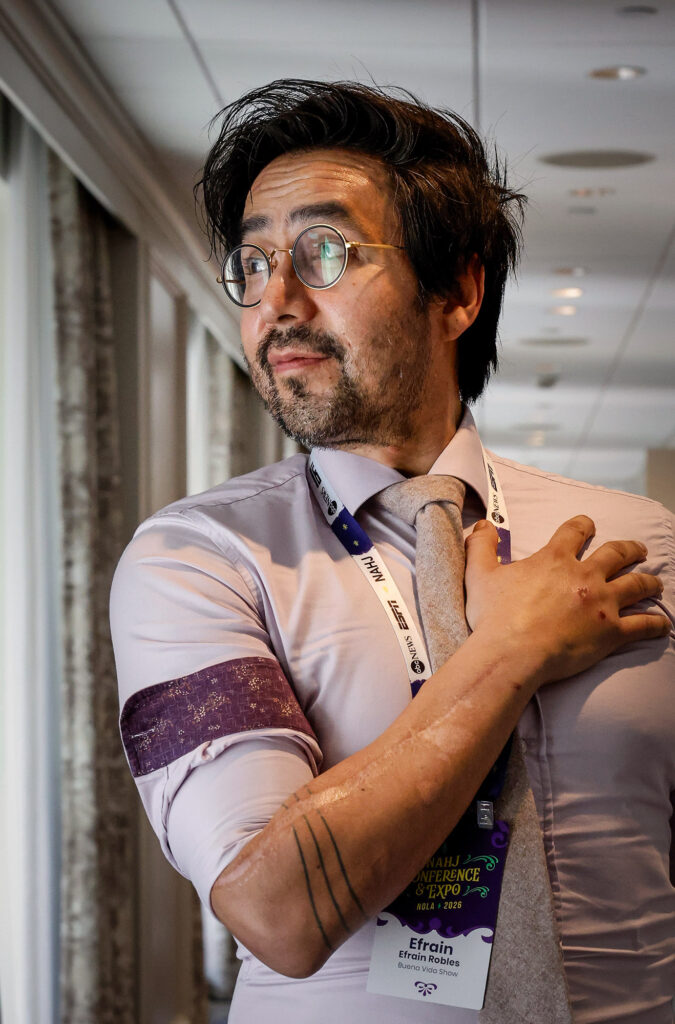
But he was rich in ideas.
Robles’ passion for photography and videography opened the doors to CBS News Sunday Morning, where he worked for nearly a decade and won three national Emmys. He shot and produced stories about America’s national parks, the Latino community’s strife during the COVID-19 Pandemic and countless profiles with some of Hollywood’s biggest stars.
In October, Robles was laid off alongside dozens of journalists, but that wasn’t his biggest challenge of the decade.
Two years ago, while shooting a story in the northern ridge of the Amazon in Colombia for his passion project “Buena Vida Show,” a bilingual documentary series showcasing culture in Latin America named after his mom’s mantra for a good life, Robles contracted a flesh-eating bacteria that invaded a small wound in his elbow and grew throughout his arm, threatening his life.
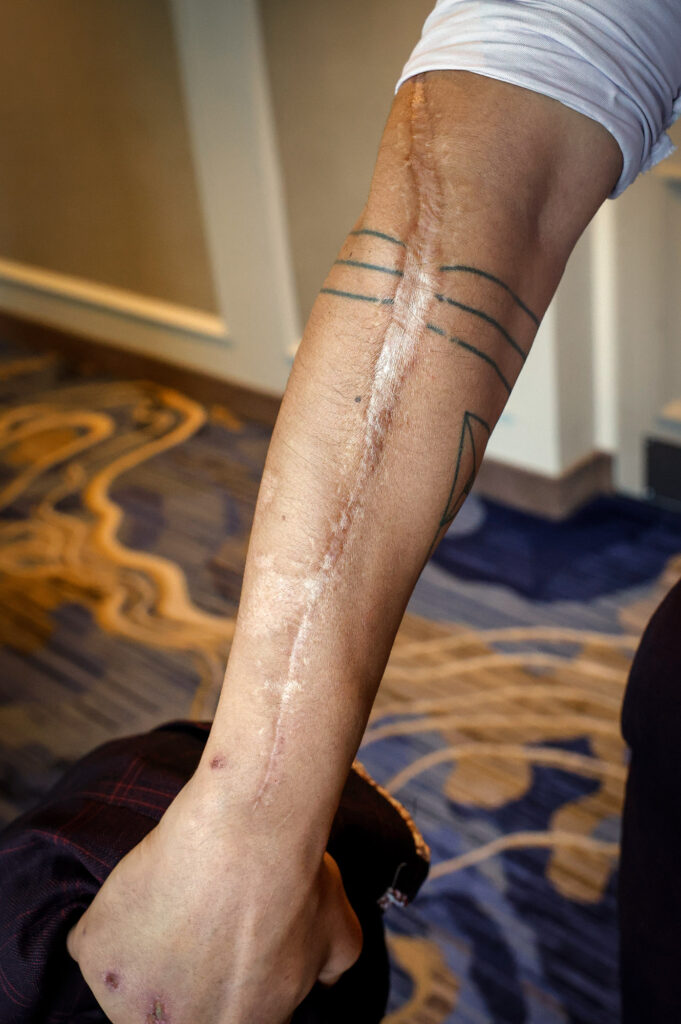
Robles underwent a procedure to cut open his arm and remove the infected areas. The wounds had to be left open for 11 days and left what he calls a “souvenir,” a long scar that runs up his wrist, cuts through the tattoos on his forearm and ends on his shoulder.
“The amount of pain and fear that collide in that moment is crushing,” Robles said, sitting with the right sleeve of his lilac dress shirt rolled up, exposing his forearm. “Few things in life are truly agony, and that was agony.”
Robles’ brush with death has allowed him to better connect with the subjects of his documentary project who, like him, have experienced ineffable pain that few people understand, he said. The layoff freed him to pursue the work he’s been wanting to devote himself to since 2021.
This week, the 43-year-old is at the 2026 National Association of Hispanic Journalists Conference and Expo in New Orleans seeking not only a job, but a partnership with someone who believes in his vision and can sponsor his documentary series.
Rather than hindering him, the hardships Robles has encountered have fueled his work, as he does everything, much like his mother, por la buena vida.
Nikole Valiente is a senior at Florida International University. She is a rural reporting fellow at Boyd’s Station in Berry, Kentucky, and aspires to become a general assignment reporter covering her hometown of Hialeah, Florida. Reach her at nikolev1023 [at] gmail [dot] com or @ni.kole.v.
