When AI comes to town: Data centers risk huge life changes
From a dancing baseball bat to a 50-part drama series about a vegetable family, generative artificial intelligence is all over social media.
The tech, marketed as a tool to optimize and increase efficiency, is often available at no cost — or so it seems.
“AI does not exist by itself,” said Ana Carolina de Assis Nunes, an anthropologist and researcher with the Data & Society Research Institute, an independent nonprofit research and policy institute that studies social, political, and economic implications of data-centric technologies, automation and AI. “There is a big apparatus that sustains the existence of AI.”
De Assis Nunes leads a team of four women who are researching the impact of AI and the massive data centers that power the technology by enabling the creation, storage and management of AI-generated content.
Data centers are spreading across the United States rapidly. There are around 4,500 data centers across the states, according to the Data Center Map, a research effort that operates a continuously updating global data center directory.
They can spread across 10,000 feet, according to one study published by the Library of Congress. The company’s figures put the U.S. as the country with the most data centers built.
North Carolina residents combat AI
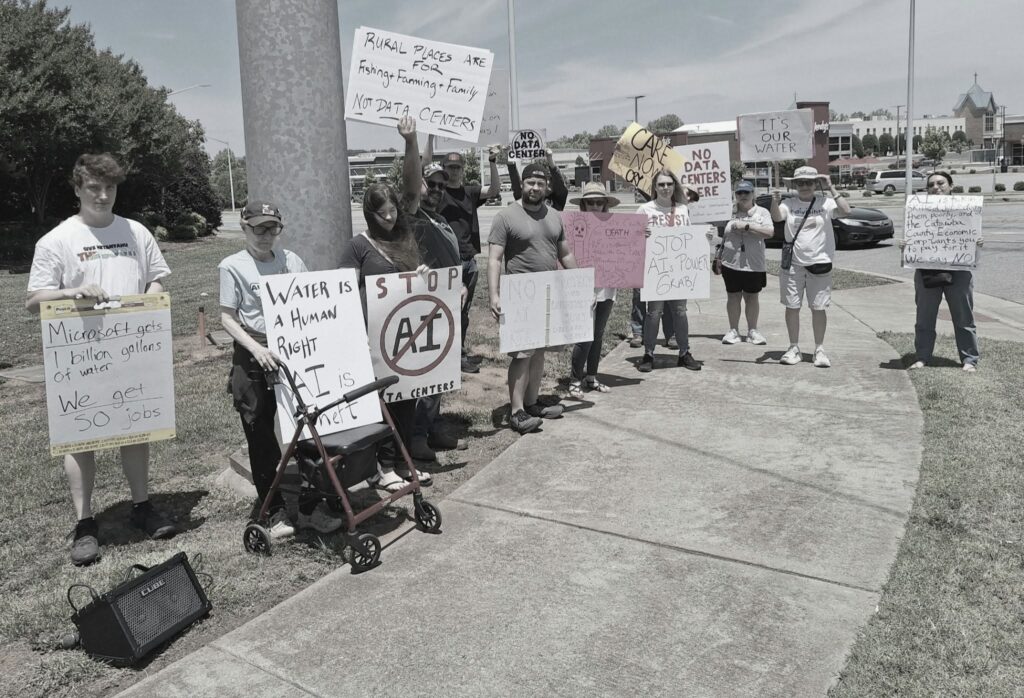
As data centers boom, the industry in the U.S. is sparking curiosity, concern and protests across communities that may soon host such facilities.
Lynnee Taylor, a Morrisville, North Carolina, resident, said she learned about plans by the company Compass Datacenters, a Texas-based developer, to build one nearby. Her gut told her something was wrong.
“It will ruin pristine farmland that has been here since it was created,” Taylor said of the facility, which can take up sizable real estate, with some occupying lots as big as several football fields. “It will disrupt the life, liberty, and the pursuit of happiness that we all are naturally gifted with.”
That’s when a few dozen residents united against the center and spent six months fighting it.
Compass Datacenters and the city government of Statesville, North Carolina, did not respond to requests for comment from the Latino Reporter.
Taylor said evaluating the proposal’s paperwork was key.
“One of the pieces of evidence said, ‘We’re not going to use so much natural water,’” Taylor said. “Therefore, we’re going to help save the citizens from having wells run dry or their city water depleted.” Taylor also said she has concerns about the quality of the water supply in her area.
The group regularly attended public hearings, met with developers and protested the plans, successfully preventing the data center’s construction.
But their success was short-lived after land owners in the nearby city of Statesville sold land to Compass.
Taylor said the paperwork to develop the data center took about two months to process. That left little time for the community to prepare to oppose the plans.
Now, the center’s construction is imminent, Taylor said. Although the data centers will not be directly in her neighborhood, her concerns linger because the data center’s water source comes from her area.
Pollutants and the impact on neighboring communities
Abre’ Conner, a lawyer and director of the Center for Environmental and Climate Justice at the NAACP, a civil rights nonprofit, said the impacts of AI data centers are very serious.
As AI use increases, so does water consumption by data centers. The Environmental and Energy Study Institute, a nonprofit based in Washington, D.C., published a report saying that “large data centers can consume up to 5 million gallons per day, equivalent to the water use of a town populated by 10,000 to 50,000 people.”
A medium-sized data center can consume up to roughly 110 million gallons of water per year, equivalent to the annual water usage of approximately 1,000 households.
According to a study by the Library of Congress, data centers can have a power draw that exceeds 100 megawatts — equivalent to the electricity needs of 80,000 U.S. households.
The amount of water consumption needed to operate and cool data centers can cause a scarcity problem and pollute water sources, said Alison Steele, executive director of the Environmental Health Project, a nonprofit public health organization. Conner said that in neighborhoods near facilities, people have already reported water contamination and murky colors.
Residents have also reported sound pollution and a constant humming noise. The nonprofit Environmental Health Project in Pittsburgh found that data centers produce sound at 90 decibels, similar to a loud lawnmower. Sound above 85 decibels is considered dangerous if heard for a prolonged time, the group said.
“It might seem not a lot at first, but when it’s constant, people report that their attention span is decreasing or they feel constantly stressed because there’s just this hum that never goes away,” De Assis Nunes said.
Air and light pollution from data centers may also have negative effects on health and quality of life, and since data centers are being built in industrialized areas, Conner said they will leave a greater impact on communities of color.
“Those places are what typically, we would consider ‘sacrifice zones,’” she said. “So then it just exacerbates the problem that communities have already been fighting to get rid of more build out.”
Ianis Soto is a senior at Sagrado Corazón University in Puerto Rico. She aspires to amplify the voices of underrepresented communities, in front of the camera and behind the scenes. You can reach her at ianisotovalle [at] gmail [dot] com or via LinkedIn.
