NAHJ brings a little New Orleans soul to members with a second line
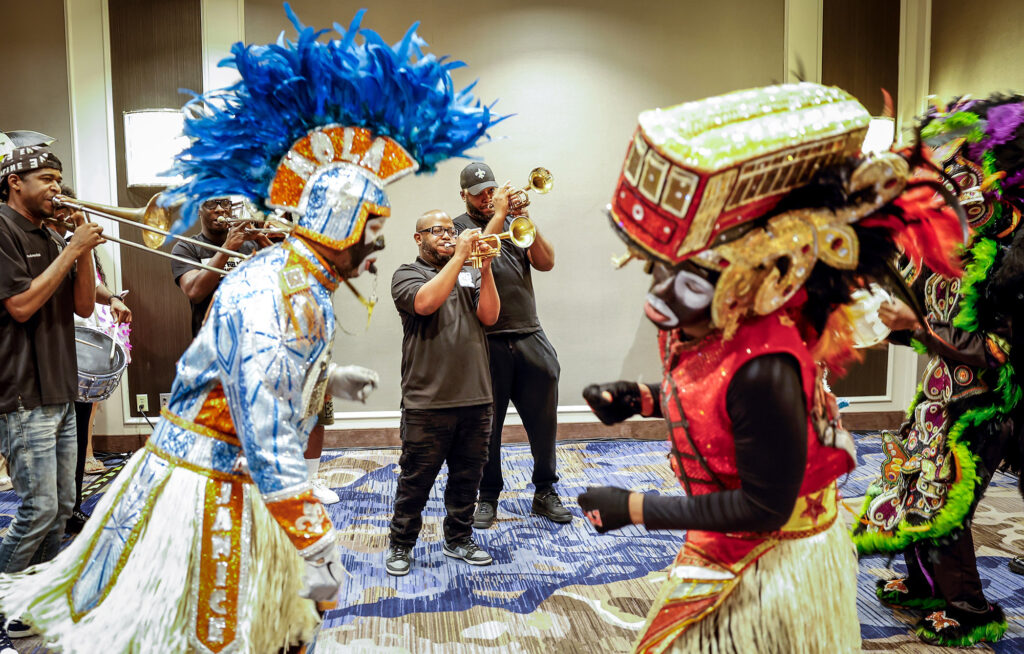
Decked out in red and gold sequins, a member of the Mardi Gras Indians bounced to the boom of drums and the blare of horns in the streets of the French Quarter. On his head, he wore a handcrafted miniature streetcar, the top ornament of his towering headdress.
As he moved, heads poked out of open doors and a swarm of Latino journalists from around the country raised their phones to capture the action.
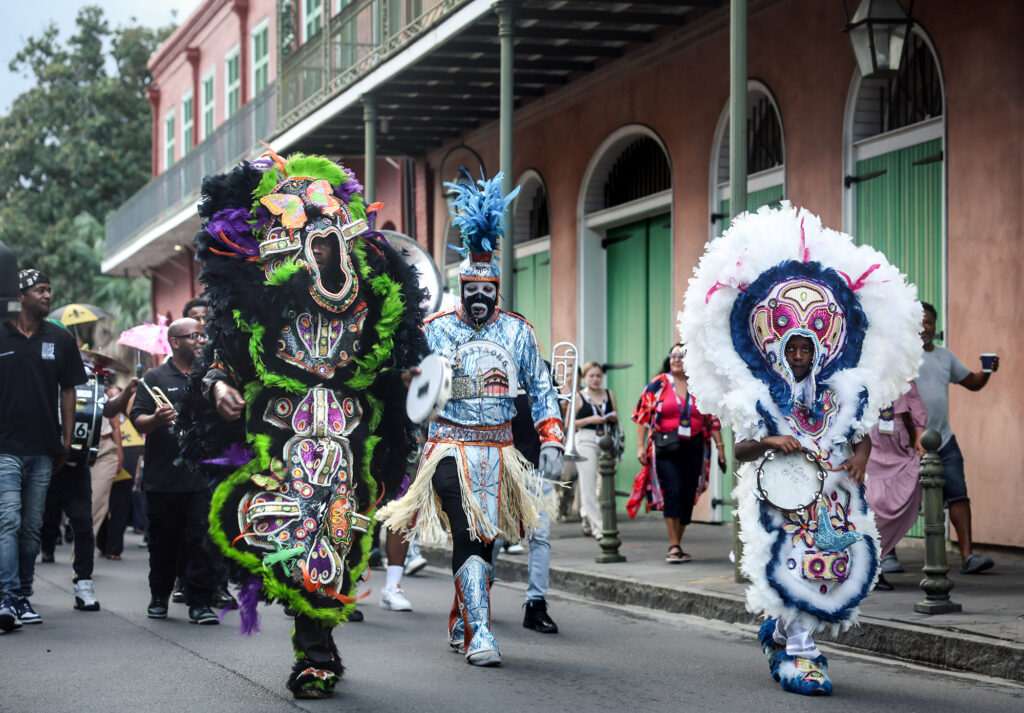
Other Mardi Gras Indians in vibrant feathers and sequins danced alongside him to the rhythm of the Big 6 Brass Band, who led the way. The second line that followed was comprised of members of the National Association of Hispanic Journalists who donned sparkly masks, feathered boas, beaded parasols and waved white handkerchiefs in the air.
They wore the colors of their regions and proudly represented their home cities and countries with flags and pins. These journalists had come from all over the world to march here, to the House of Blues at the national conference’s kick-off parade.
Second-line parades are a New Orleans tradition typically led by a brass band, the main group, called the “first line.” The community that follows close behind them is jubilant, creating the parade’s “second line.”
The man in the streetcar outfit is Myron Thibodeaux Jr., a member of the Zulu Social Aid and Pleasure Club, a well-known Mardi Gras krewe. He made his headdress by hand out of cardboard and wire. The Zulus are known for the biggest parade on Mardi Gras Day, and frequently participate in other events and marches all year for the community.
On his waist, in bold white letters was the word: “EVERYWHERE.”
“That’s the name that I go by,” he said. “And the reason why I’m ‘Everywhere’ [is] because I’m everywhere.”
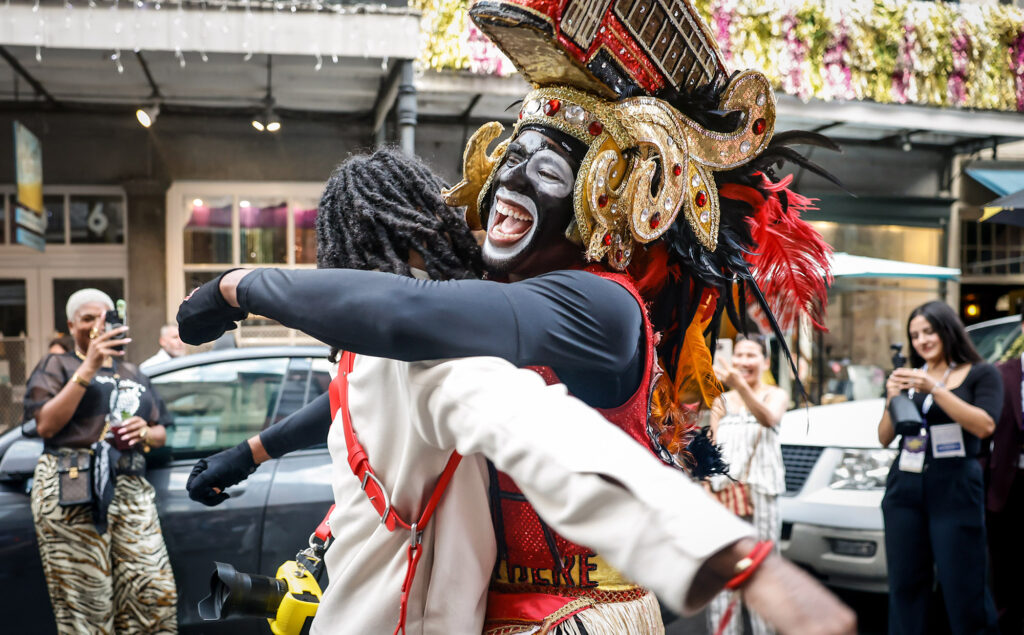
Thibodeaux Jr. has been dancing with the group for nearly 4 years, but has been participating in these types of parades since childhood. He said he loves feeding off of the crowd’s energy. By seeing everyone’s outfits, colorful handkerchiefs and bedazzled umbrellas, he was “on the high” of the celebration.
NAHJ leaders said the organization, which represents Latino journalists around the world, held the conference in New Orleans because the city has been a key part of Spanish-language media’s history in the United States.
In the 1800s, the country’s first Spanish-language newspaper, “El Misisipi,” was published here. An homage to this history preceded the parade at an opening ceremony hosted by NAHJ President Dunia Elvir.
NAHJ members like Sophia Rentschler said she appreciated the event because it felt so authentic to the city’s culture.
“I think that the fact that we’re embracing, as NAHJ, New Orleans’s history is really important because I think it celebrates the intersectionality of the Latino community,” Rentschler said. “The people that were … leading the parade also were representative of this rich culture that’s present in the city, and I thought it was really vibrant.”
Rentschler said when she came to New Orleans, she knew she wanted to find a way to experience the city’s rich culture of jazz. Little did she know that she’d actually be a part of it.
“The deep history of jazz and its impact on so many cultural legends here is such an important piece of the city,” she said. “It was really cool to hear that in person.”
But Thibodeaux Jr. said the march gave visitors just a small taste of the city’s culture.
“It’s a lifestyle, it’s a part of our heart, it’s a part of our soul, and it’s just more than dancing and having fun,” he said. “You will enjoy the upbeat positivity that comes along with it, the excitement that everyone brings, and you will go home with a memory.”
Lizbeth Solorzano is a recent graduate from the University of Southern California’s masters program and works as an investigative intern for L.A. TACO. As a bilingual multimedia journalist, her interests include arts, culture and community news. You can reach her via Instagram @llizbeth.so.
