How Laura Rodríguez Presa went from journaling to Pulitzer journalism
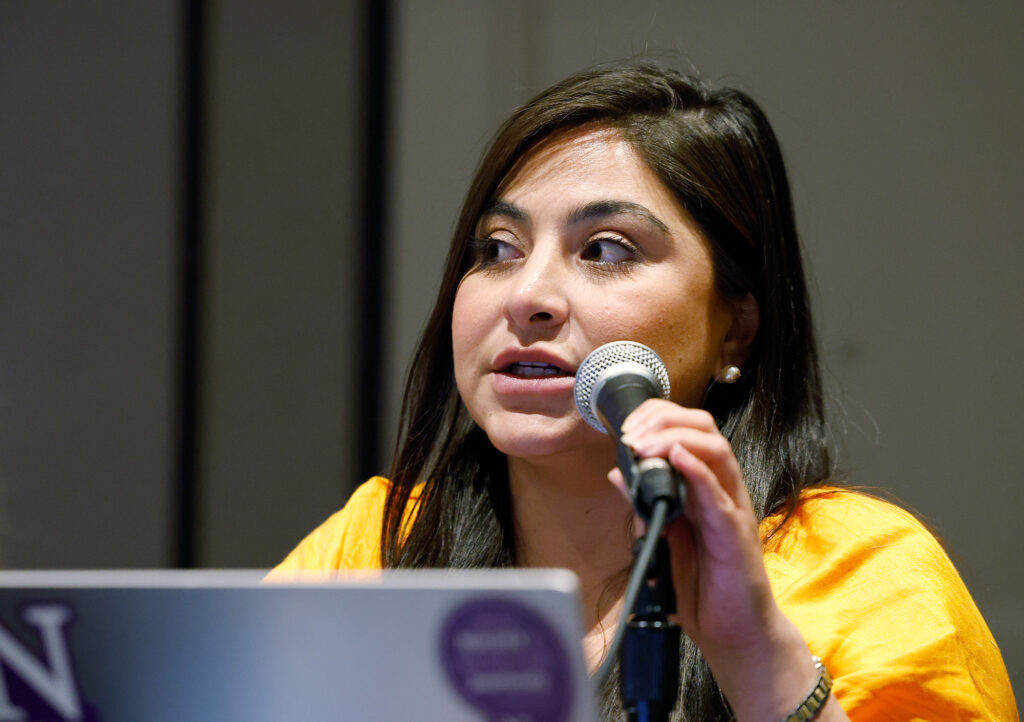
Long before receiving a Pulitzer Prize, Laura Rodríguez Presa was a young girl from San Vicente Cerro Prieto, a small town in Guanajuato, who used her journals and notebooks as a way to tell the stories that others overlooked.
Years later, her drive to document the experiences of overlooked communities guided Rodríguez Presa toward journalism. She wanted to reshape how immigrant stories were told.
This year, Rodríguez Presa was part of the Chicago Tribune team’s Pulitzer Prize-winning immigration coverage.
Among the recognized stories was her investigation, “Dehumanizing: Inside the Broadview ICE Facility Where Immigrants Sleep on Cold Concrete,” in which she documented, alongside Joe Mahr, allegations that immigrants detained at an U.S. Immigration and Customs Enforcement processing facility in Illinois were forced to sleep on concrete floors with limited access to food, water, medical care and legal representation.
For Rodríguez Presa, the award was not a validation of her work but rather confirmation that her purpose since childhood is making a meaningful impact.
“The Pulitzer was a recognition that helped solidify the path I have followed throughout all these years. It made me realize that the goal I had set for myself had truly been achieved,” she said.
For Rodríguez Presa, the prize also represents a shift in the public conversation surrounding the Latino community and demonstrates that narratives can change when journalists are committed to telling stories through a human-centered lens.
Arriving in Chicago
Rodríguez Presa’s grandfather immigrated to the United States as a young man and gained immigration status through the 1986 Immigration Reform and Control Act amnesty program. The process paved the way for his family to reunite years later for a new life in the U.S.
At the age of 10, Rodríguez Presa and her family embarked on the same path. They packed their belongings and moved to Chicago in search of better opportunities.
That experience, together with her ancestors’ paths, shaped her perspective on immigration and ultimately defined the direction of her journalism career.
“I realized there was a need to tell immigrants’ stories because you rarely saw stories about resilience, love, hard work, or how immigrants are an integral part of society,” Rodríguez Presa said.
In her view, the media often failed to reflect the complexity of Latino communities.
The stories she encountered were frequently tied to stereotypes of poverty, crime, or hardship, while narratives highlighting immigrants’ perseverance, culture and contributions were largely absent.
When she was a teenager, a high school teacher encouraged Rodríguez Presa to join the school’s journalism club, a vital experience.
Path to journalism
Although she arrived in the U.S. without speaking English fluently, Rodríguez Presa stood out for her writing ability and quickly began developing her journalism skills.
She often served as her parents’ translator on legal matters.
After enrolling at DePaul University in Chicago, she explored several academic fields before realizing that journalism was her true calling. She ultimately earned a degree in journalism with a concentration in Latino media and a minor in Spanish.
During her time in college, Rodríguez Presa studied under acclaimed Latina journalist Maria Hinojosa, who shaped her understanding of Latino representation in the news industry.
“I came to understand what the world of journalism was really like and how difficult it was to be a Latina in a profession that was still largely led by white men,” she recalled.
Through her work, Rodríguez Presa has become part of a new generation of Latino journalists committed to expanding the voices represented in the media and ensuring that communities historically overlooked are seen and heard.
“El periodismo no es una carrera, es una vocación”, dijo Rodríguez Presa. “Narratives can change, but it takes a great deal of work. It takes time, but it is possible when your intentions are genuine.”
Looking ahead, she hopes to leave a legacy grounded in the belief that journalism is a public service.
Yarithza Liceaga López, graduada de la Universidad de Puerto Rico en Arecibo. Aspiro a continuar ejerciendo un periodismo comunitario y multimedia, dando visibilidad a quienes más lo necesitan. Contáctame en yarithza.liceaga@upr.edu o en Instagram como @yaya.liceaga.
